Current Context
Overall, it seems Asia's broad and deep environmental problems are in fact threatening the security of its people. Issues stemming from poor practices are flooding, water scarcity, loss of crops, death, and homelessness. These issues threaten species, health, and the economy so they should be considered security issues.
So why are they not security issues?
Several factors have been cited as to why the environment doesn't fall under the traditional, realist vision of security in East Asian nations. Among them are historical tensions from wars and general mistrust between nations, military and arms build-up, and the view that security is a state issue where nations protect their own from foreign entities. There are little to no multilateral alliances among nations and bilateral agreements are prominent. This means that the regional issue of the environment has no hope of being resolved in such a nationalist area of the world. Also, the presence of the U.S., another military-security focused nations, lends to the increasing view that the environment is not a concern of security.
What needs to occur
In my opinion, East Asian nations need to give more support to the regional organizations they have already established for environmental issues. They need to give up some national power to the overreaching entities so they can deal with the environment as the state-line crossing problem it is. These organizations need to make the regulations they agree upon legally binding rather than just guidelines. The health, economy, and security of East Asia depends upon taking a new stance to the issue and putting aside military suspicions and rivalries. They must also address the issue of an ever-expanding economy and use of resources. They need to stop focusing on miltary spending and instead give these resources to its people so they can stop over-cultivating the land just to survive.
Tuesday, March 4, 2008

Sunday, March 2, 2008
China's Environmental Problems Are Not Just China's Problems
The Great Leap Backward?; The Costs of China's Environmental Crisis
In this article, Elizabeth Economy believes that China's recent economic progress is causing a massive environmental decline that may reverse all of China's success and cause the Communist party to lose everything it has gained. She blames local people for wasting resources, local governments for being corrupt and not enforcing laws, factories for ignoring reforms, MNCs for inefficiency and lack of concern, the Chinese government for withholding information while not providing incentives to be more environmentally friendly, and, finally, the International community for both placing too much pressure on China to perform economic miracles and not providing a model of environmental reform for the nation to follow. There are a whole list of problems and consequences with few solutions and the Communist government may lose out whether they do or they don't.
Bottom Up Approach
This is an absolutely necessary approach to turning around China's environmental sins. Economy emphasizes that the government can impose restrictions and offer incentives but it must be NGOs, local governments, factories, and the people that call for the reforms. Local businesses have some of the worst emissions rates and need incentives to stop. As it is right now, it is cheaper to violate environmental laws and pay fines than spend the money to fix their factories.
It is only the bottom that can enforce environmental change. These people are NGOs who can educate a broader population more effectively than the government or international agencies can. These groups, along with the population, see the damage being caused to China and the consequences of pollution so they know better than anyone what needs to happen and how it can happen.
What is going on over there?
This is just a brief, succinct list of all problems in China:
1) Consumed 2.4 billion tons of coal in 2006 (the number is rising)
2) China has 16 of 20 most polluted cities in the world
3) 14,000 new cars hit the road every day in China (more gas emissions)
4) Urbanization, the inefficient way buildings are being constructed, and the increase in electronic appliance use because of this
5) Deforestation from timber needs, soil contamination from acid rain, loss of biodiversity, and desertification
6) Climate change
7) Water shortages from leaky pipes, agricultural needs, polluted water, less rain
And the list of environmental problems this causes:
1) Acid rain in China, Japan, Korea and pollutants in U.S.
2) Pollution in Pacific Ocean
3) Loss of seafood supply
4) Largest CO2 emitter in the world
5) Deforestation in other areas of the world from illegal timber consumption
And the list of economic problems this causes:
1) 8-12% of GPD spent on environmental problems
2) Provinces are producing oil and paying costs for environmental and health damage
3) Health costs
-19-23% rise in cancer
-750,000 respitory illness related deaths
-190 million people sick from contaminated water
-Disease, lukemia
And the list of social costs:
1) 51,000 protests in one year
2) Peaceful protests have turned violent and subsequently shut down by government
3) Videos and websites on the Internet expose the social unrest in China to the world
4) Communist party worries its stability is at stake
What Will China Do?
In the past China has had problems and attempted (or at least claim to have attempted) solutions. So far, they have pledged to reduce energy inefficency, increase renewable energy sources, and other goals and already have they reduced such goals. Even in the face of the Olympics, they have made some changes (planting trees, outlawing many cars) and cut back some goals because they are unrealistic or too costly to their economic progress.
SEPA, China's equivalent to the EPA, is trying a grassroots approach to making such changes. While this may be the only way to affect change, it's not working. SEPA lacks authority with local governments. They are trying to make assessments of environmental damage and issuing laws to correct them but barely 10% of such laws get enforced.
The problem is SEPA lacks the ability to give incentives for compliance. This is where the government comes in. They must be more transparent with information and allow the extent of the environmental damage to be released to the public. Then, they must raise fines for breaking laws and stop corrupt officials from taking bribes to let factories slip past laws. They must also stop pressuring the Chinese to quadruple its economy by 400%! The biggest detriment to the environmental crisis is pressure to be as efficient and profitable as possible and many times this means being environmentally unsustainable. In the end, the cost will far outweigh the savings and growth China is experiencing now.
Who's to blame?
1)MNCs are being blamed by the Chinese government for pressuring Chinese factories to produce too much. They are not operating with sustainable practices. They are not calling for reform because it would be too costly. They are contributing, as the previous article also supports, to pollution with e-waste. MNCs do not remove business if they find out a factory is polluting too much and they need to be.
2)Domestic Factories and People MNCs claim that it is the local factories and local population that contribute even more greatly to pollution.
3)Chinese Government for cracking down on activists. They allow small protests but shut down anything they feel is threatening the party. They are not enforcing laws and even the laws they enforce do not fine enough to give incentive to change. The government is also not transparent enough about the extent of the environmental crisis. They are pressuring businesses too hard to achieve huge economic gains.
4)Foreign Governments The Chinese pollution is affecting the entire world. However, U.S. and other nations that are calling for China to stop its pollution also need to make domestic reforms. In order to be an authority to China on climate change and environmental change, the U.S. must reform itself, too.
So what's the problem
The environment is at risk. However, the cost to start environmental reform and restructure businesses to be more sustainable is too much up front. It's hard for China to realize the potential future savings and they are not willing to take an economic hit for it.
Also, the Communist system is at risk. The government does not want to be democratized and they feel the conditions needed for environmental change (transparency, media access, and more power to NGOs) will undermine Communist ideals.
The only way for China to turn this around is to start from the bottom up. Factories need to call for incentives to slow CO2 emissions and pollution. Media needs to call for more freedom and transparency of information. MNCs and foreign companies need to realize the importance of the environment and take an economic hit. They need to slow demand for goods and provide a model for change by changing their own practices abroad. NGOs need to gain more power, educate the masses, and provide resources for changing.
I feel that without slow and steady, grassroots progress, China's water source will diminish, forests will turn to desert, the air quality will make many regions unlivable, and China's reputation will be forever tarnished. China may think they are securing their future by growing economically, but they are actually ensuring failure by ignoring its environmental concerns.
In this article, Elizabeth Economy believes that China's recent economic progress is causing a massive environmental decline that may reverse all of China's success and cause the Communist party to lose everything it has gained. She blames local people for wasting resources, local governments for being corrupt and not enforcing laws, factories for ignoring reforms, MNCs for inefficiency and lack of concern, the Chinese government for withholding information while not providing incentives to be more environmentally friendly, and, finally, the International community for both placing too much pressure on China to perform economic miracles and not providing a model of environmental reform for the nation to follow. There are a whole list of problems and consequences with few solutions and the Communist government may lose out whether they do or they don't.
Bottom Up Approach
This is an absolutely necessary approach to turning around China's environmental sins. Economy emphasizes that the government can impose restrictions and offer incentives but it must be NGOs, local governments, factories, and the people that call for the reforms. Local businesses have some of the worst emissions rates and need incentives to stop. As it is right now, it is cheaper to violate environmental laws and pay fines than spend the money to fix their factories.
It is only the bottom that can enforce environmental change. These people are NGOs who can educate a broader population more effectively than the government or international agencies can. These groups, along with the population, see the damage being caused to China and the consequences of pollution so they know better than anyone what needs to happen and how it can happen.
What is going on over there?
This is just a brief, succinct list of all problems in China:
1) Consumed 2.4 billion tons of coal in 2006 (the number is rising)
2) China has 16 of 20 most polluted cities in the world
3) 14,000 new cars hit the road every day in China (more gas emissions)
4) Urbanization, the inefficient way buildings are being constructed, and the increase in electronic appliance use because of this
5) Deforestation from timber needs, soil contamination from acid rain, loss of biodiversity, and desertification
6) Climate change
7) Water shortages from leaky pipes, agricultural needs, polluted water, less rain
And the list of environmental problems this causes:
1) Acid rain in China, Japan, Korea and pollutants in U.S.
2) Pollution in Pacific Ocean
3) Loss of seafood supply
4) Largest CO2 emitter in the world
5) Deforestation in other areas of the world from illegal timber consumption
And the list of economic problems this causes:
1) 8-12% of GPD spent on environmental problems
2) Provinces are producing oil and paying costs for environmental and health damage
3) Health costs
-19-23% rise in cancer
-750,000 respitory illness related deaths
-190 million people sick from contaminated water
-Disease, lukemia
And the list of social costs:
1) 51,000 protests in one year
2) Peaceful protests have turned violent and subsequently shut down by government
3) Videos and websites on the Internet expose the social unrest in China to the world
4) Communist party worries its stability is at stake
What Will China Do?
In the past China has had problems and attempted (or at least claim to have attempted) solutions. So far, they have pledged to reduce energy inefficency, increase renewable energy sources, and other goals and already have they reduced such goals. Even in the face of the Olympics, they have made some changes (planting trees, outlawing many cars) and cut back some goals because they are unrealistic or too costly to their economic progress.
SEPA, China's equivalent to the EPA, is trying a grassroots approach to making such changes. While this may be the only way to affect change, it's not working. SEPA lacks authority with local governments. They are trying to make assessments of environmental damage and issuing laws to correct them but barely 10% of such laws get enforced.
The problem is SEPA lacks the ability to give incentives for compliance. This is where the government comes in. They must be more transparent with information and allow the extent of the environmental damage to be released to the public. Then, they must raise fines for breaking laws and stop corrupt officials from taking bribes to let factories slip past laws. They must also stop pressuring the Chinese to quadruple its economy by 400%! The biggest detriment to the environmental crisis is pressure to be as efficient and profitable as possible and many times this means being environmentally unsustainable. In the end, the cost will far outweigh the savings and growth China is experiencing now.
Who's to blame?
1)MNCs are being blamed by the Chinese government for pressuring Chinese factories to produce too much. They are not operating with sustainable practices. They are not calling for reform because it would be too costly. They are contributing, as the previous article also supports, to pollution with e-waste. MNCs do not remove business if they find out a factory is polluting too much and they need to be.
2)Domestic Factories and People MNCs claim that it is the local factories and local population that contribute even more greatly to pollution.
3)Chinese Government for cracking down on activists. They allow small protests but shut down anything they feel is threatening the party. They are not enforcing laws and even the laws they enforce do not fine enough to give incentive to change. The government is also not transparent enough about the extent of the environmental crisis. They are pressuring businesses too hard to achieve huge economic gains.
4)Foreign Governments The Chinese pollution is affecting the entire world. However, U.S. and other nations that are calling for China to stop its pollution also need to make domestic reforms. In order to be an authority to China on climate change and environmental change, the U.S. must reform itself, too.
So what's the problem
The environment is at risk. However, the cost to start environmental reform and restructure businesses to be more sustainable is too much up front. It's hard for China to realize the potential future savings and they are not willing to take an economic hit for it.
Also, the Communist system is at risk. The government does not want to be democratized and they feel the conditions needed for environmental change (transparency, media access, and more power to NGOs) will undermine Communist ideals.
The only way for China to turn this around is to start from the bottom up. Factories need to call for incentives to slow CO2 emissions and pollution. Media needs to call for more freedom and transparency of information. MNCs and foreign companies need to realize the importance of the environment and take an economic hit. They need to slow demand for goods and provide a model for change by changing their own practices abroad. NGOs need to gain more power, educate the masses, and provide resources for changing.
I feel that without slow and steady, grassroots progress, China's water source will diminish, forests will turn to desert, the air quality will make many regions unlivable, and China's reputation will be forever tarnished. China may think they are securing their future by growing economically, but they are actually ensuring failure by ignoring its environmental concerns.
Saturday, March 1, 2008
Toxic Toys Topple Tiny Tots and Trendy Teens
China: Lead Toxins Take a Global Round Trip
The article by Fairclough takes over from last weeks readings sighting poor conditions and laws in China as part of the blame for toxic materials in Chinese exports. However, Fairclough sights another problem as even more cause for concern. That problem is e-waste recycling from the U.S.
There is a global issue at hand in which a cycle causes China to manufacture items with lead, the U.S. to send the recycled remnants of such products back to China, and China to reuse their materials in new items destined to be shipped back to the U.S. all over again.
Jewelry is a huge export from China, making up 70% of the $4.5 billion industry and 6.7 billion pieces of such exports were recalled in 2007. This is huge both for China and the U.S. This means a great deal of U.S. imports are toxic and China is paying the price for recalling them.
Another item caught in this mess is e-waste, such as computers and cell phones. 50 millions tons of the stuff is tossed every year in the U.S. and sent back to China to be reused. Much of the materials are put into new electronics, the jewelry mentioned above, and toys while much of it is simply dumped in various places in China. This means more poisoning in exports and poisoning of the Chinese environment. None of this cycle is regulated by the U.S. or Chinese environmental protection bureaus. Both China and the U.S. stand to lose health and environment battles in this case.
Why is lead so bad? It causes brain damage and death from exposure or, more harmfully, from ingestion. This harms U.S. children, teens, and others who use the goods and also harms the workers that make them. The lack of labor laws in China allow workers to touch and inhale toxins from the materials as they manufacture them into products. Again, China and U.S. citizens are putting their health at risk and increasing medicals costs when resulting conditions need to be treated.
Ok, another question. Why is this being allowed to happen? The answer is, as usual, money. Lead alloy is way cheaper than other materials, more abundant, and more pliable. U.S. and other major customers of China want the lowest cost.
Is there another way? Yes. Many companies claim to offer their customers the choice of lead-free products but most decline because of the cost. Then, companies fight back saying they are not aware of the lead content in the products they contract from Chinese factories. Who's right and who's not?
So, the last question for now... What can and is being done about it? The U.S. has decided to begin researching the global scope of the lead poisoning problem but this is no easy task. For now, consumers simply need to be informed that, while recycling is good in most cases, it may be putting more chemicals back into both China and the U.S. than once thought. Oh bother.
The article by Fairclough takes over from last weeks readings sighting poor conditions and laws in China as part of the blame for toxic materials in Chinese exports. However, Fairclough sights another problem as even more cause for concern. That problem is e-waste recycling from the U.S.
There is a global issue at hand in which a cycle causes China to manufacture items with lead, the U.S. to send the recycled remnants of such products back to China, and China to reuse their materials in new items destined to be shipped back to the U.S. all over again.
Jewelry is a huge export from China, making up 70% of the $4.5 billion industry and 6.7 billion pieces of such exports were recalled in 2007. This is huge both for China and the U.S. This means a great deal of U.S. imports are toxic and China is paying the price for recalling them.
Another item caught in this mess is e-waste, such as computers and cell phones. 50 millions tons of the stuff is tossed every year in the U.S. and sent back to China to be reused. Much of the materials are put into new electronics, the jewelry mentioned above, and toys while much of it is simply dumped in various places in China. This means more poisoning in exports and poisoning of the Chinese environment. None of this cycle is regulated by the U.S. or Chinese environmental protection bureaus. Both China and the U.S. stand to lose health and environment battles in this case.
Why is lead so bad? It causes brain damage and death from exposure or, more harmfully, from ingestion. This harms U.S. children, teens, and others who use the goods and also harms the workers that make them. The lack of labor laws in China allow workers to touch and inhale toxins from the materials as they manufacture them into products. Again, China and U.S. citizens are putting their health at risk and increasing medicals costs when resulting conditions need to be treated.
Ok, another question. Why is this being allowed to happen? The answer is, as usual, money. Lead alloy is way cheaper than other materials, more abundant, and more pliable. U.S. and other major customers of China want the lowest cost.
'It's too costly to make lead-free products,' says owner Wang Quijuan. 'Chinese products have to be sold cheaply in foreign markets, or they are not competitve.'It's clear, here, that the blame is to, like labor issues, be blamed on foreign companies for pressuring China to be too cheap. I can see it that way but China should also be taking care of its products and its people.
Is there another way? Yes. Many companies claim to offer their customers the choice of lead-free products but most decline because of the cost. Then, companies fight back saying they are not aware of the lead content in the products they contract from Chinese factories. Who's right and who's not?
So, the last question for now... What can and is being done about it? The U.S. has decided to begin researching the global scope of the lead poisoning problem but this is no easy task. For now, consumers simply need to be informed that, while recycling is good in most cases, it may be putting more chemicals back into both China and the U.S. than once thought. Oh bother.
Tuesday, February 26, 2008
Is it possible that the U.S. is actually more to blame than China for labor abuse???
U.S. Senate testimony regarding commerce, science, and transportation
We read the testimony by Charles Kernaghan, the Director of National Labor Committee. This plea to the Senate essentially reinforces the hardships and lack of justice we observed in the documentary on Lifeng.
Violating Workers' Rights
Laborers are forced into temporary contracts so that they do not have any rights with the company. They are paid hundreds of percentages below China's legal minimum wage and work hundreds of percentages of hours more than legally allowed in the nation. Workers are docked pay for unfair reasons and shortchanged their earned pay for absolutely no reason. The labor board director emphasizes over and over again that factories all over China are guilty of the exact same violations, just on greater or lesser scales.
The Apparent Solution
The hugest injustice is that at least the problem of pay could be resolved with little effect felt throughout major corporations. Kernaghan states that,
All of this, it can be argued, is magnified, if not caused by U.S. corporations. Like the doc. showed, Kernaghan is serious about placing a lot of blame on American and European brands for pressuring China to lower prices and increase outputs at the cost of Chinese workers' rights.
Another example of how we can sense that foreign investors are to blame for the labor crisis is the fact that most corporations refuse to publish the names and addresses of the factories they obtain supplies from in China. Clearly, something is being hidden here or the companies are simply ashamed.
The injustices are mounting here, they are real, and there seems to be no way out unless this testimony is well-received and governments start to take action. This is interesting, however, because the documentary seems to try and blame both the consumer and business for such harmful actions and this memo blames U.S. and European companies way more.
Relating to Health of U.S. Citizens May Spark Support
Keranghan also pulls the issue of toy and sporting goods safety into the issue. He states that the same actions of increasing what foreign companies pay Chinese factories per good and giving workers rights will also help to lessen the occurrence of poisoning in toys because conditions in factories will be much better. In the instance, it seems he is trying to make giving help to China's workers a win-win situation for the U.S. My only wish is that he proved how the two correlated better.
Labor Rights in China
It comes of no surprise that Tim Costello, Brenden Smith, and Jeremy Brecher have all come to understand the same point that Kernanghan was trying to make. There are Chinese laws for workers' rights and corporations are outright refusing to follow them citing economic interests as the reason.
Oh, Wal-Mart
Ok, so it's not just Wal-Mart but it figures they would be a part of this, too. Many companies, like Mattel, are not allowing China to pass more strict labor laws that would significantly help the treatment, health, safety, and renumeration of workers because such laws would "reduce employment opportunities for PRC workers," (I'm sorry, is that a threat? I thought these laws would significantly increase human welfare for PRC workers!) and also reduce China's competitive edge against other sweatshop nations, such as Mexico, with slightly higher wages for workers.
How can corporations make such threats? Easy, they are the number one reason China is even where it is in the world economy today.
Again, Relating the Problem Back to the U.S. Will Draw Support
If only U.S workers knew that the wages and state of labor in China indirectly created the wages and conditions in the U.S. and other labor markets throughout the whole world. The crazy thing is, they do. Because companies can get cheaper wages from Chinese workers, they are either moving their business to Asia or using this as leverage to get U.S. workers to accept lower pay as well.
The logic behind the phenomenon is this: China has increased the world labor market by 50% without contributing as must in capital. There are more workers in need of employment and wages than there is living-wage equivalent capital to go around. Thus, when one loses so does the other.
The point is, again, it's up to U.S. and European governments to make good on their commitments. They have all said their MNCs would stand to protect labor and so far they have done the exact opposite. This hurts China's workers and the U.S.'s workers and places economic values about ethical and moral values. In what world does this make sense?
We read the testimony by Charles Kernaghan, the Director of National Labor Committee. This plea to the Senate essentially reinforces the hardships and lack of justice we observed in the documentary on Lifeng.
Violating Workers' Rights
Laborers are forced into temporary contracts so that they do not have any rights with the company. They are paid hundreds of percentages below China's legal minimum wage and work hundreds of percentages of hours more than legally allowed in the nation. Workers are docked pay for unfair reasons and shortchanged their earned pay for absolutely no reason. The labor board director emphasizes over and over again that factories all over China are guilty of the exact same violations, just on greater or lesser scales.
The Apparent Solution
The hugest injustice is that at least the problem of pay could be resolved with little effect felt throughout major corporations. Kernaghan states that,
Mattel's 'Barbie Hug N' Heal Pet Doctor' set costs just $9.00 to make in China, yet- even on sale- it retails for $29.99 in the U.S. This means that the price of the Mattel toy is being marked up an astonishing $20.99- or 233 percent... Mattel spends $3.45 to advertise the Barbie Pet Doctor toy- more than 18 times the 19 cents they pay the workers in China to make it... It is clear that Mattel could afford to assure respect for workers rights in China and pay the workers a fair wage so they could climb out of misery and at least into poverty.This is an astonishing perspective to finally see and I hope that it is true. However, one must also think that if Mattel did not advertise with such fervor and pay its leaders so well, would it be competitive and profitable enough to even stay in business nationally? Is the economic price worth the moral price?
All of this, it can be argued, is magnified, if not caused by U.S. corporations. Like the doc. showed, Kernaghan is serious about placing a lot of blame on American and European brands for pressuring China to lower prices and increase outputs at the cost of Chinese workers' rights.
As late as 2005, Mattel sought ands won special 'waivers' so they could pay their workers less than the already-below-subsistence legal minimum wage.Clearly, the Chinese government is seeking to offer its own people some form of protection but Mattel, fearing a loss in revenue, has pressed them to make an exception in their case.
Another example of how we can sense that foreign investors are to blame for the labor crisis is the fact that most corporations refuse to publish the names and addresses of the factories they obtain supplies from in China. Clearly, something is being hidden here or the companies are simply ashamed.
The injustices are mounting here, they are real, and there seems to be no way out unless this testimony is well-received and governments start to take action. This is interesting, however, because the documentary seems to try and blame both the consumer and business for such harmful actions and this memo blames U.S. and European companies way more.
Relating to Health of U.S. Citizens May Spark Support
Keranghan also pulls the issue of toy and sporting goods safety into the issue. He states that the same actions of increasing what foreign companies pay Chinese factories per good and giving workers rights will also help to lessen the occurrence of poisoning in toys because conditions in factories will be much better. In the instance, it seems he is trying to make giving help to China's workers a win-win situation for the U.S. My only wish is that he proved how the two correlated better.
Labor Rights in China
It comes of no surprise that Tim Costello, Brenden Smith, and Jeremy Brecher have all come to understand the same point that Kernanghan was trying to make. There are Chinese laws for workers' rights and corporations are outright refusing to follow them citing economic interests as the reason.
Oh, Wal-Mart
Ok, so it's not just Wal-Mart but it figures they would be a part of this, too. Many companies, like Mattel, are not allowing China to pass more strict labor laws that would significantly help the treatment, health, safety, and renumeration of workers because such laws would "reduce employment opportunities for PRC workers," (I'm sorry, is that a threat? I thought these laws would significantly increase human welfare for PRC workers!) and also reduce China's competitive edge against other sweatshop nations, such as Mexico, with slightly higher wages for workers.
How can corporations make such threats? Easy, they are the number one reason China is even where it is in the world economy today.
65% of the tripling of Chinese exports... is traceable to outsourcing by Chinese subsidiaries of multinational corporations (MNCs) and joint ventures.Essentially, do what we say or we will ruin your entire economy and you'll be even worse off than you are now.
Again, Relating the Problem Back to the U.S. Will Draw Support
If only U.S workers knew that the wages and state of labor in China indirectly created the wages and conditions in the U.S. and other labor markets throughout the whole world. The crazy thing is, they do. Because companies can get cheaper wages from Chinese workers, they are either moving their business to Asia or using this as leverage to get U.S. workers to accept lower pay as well.
The logic behind the phenomenon is this: China has increased the world labor market by 50% without contributing as must in capital. There are more workers in need of employment and wages than there is living-wage equivalent capital to go around. Thus, when one loses so does the other.
The point is, again, it's up to U.S. and European governments to make good on their commitments. They have all said their MNCs would stand to protect labor and so far they have done the exact opposite. This hurts China's workers and the U.S.'s workers and places economic values about ethical and moral values. In what world does this make sense?
Sunday, February 24, 2008
Labor in China
Elite, Middle Class, and the Poor
In his article regarding the distinct classes in China, T. Cheek explores the characteristics and problems of each and why the government will never be able to satisfy everyone under the current system.
The Elite
This group is the wealthiest and has little to worry about. They drive luxury cars and live for money. This group fears an upprising from the poor and seek to keep the government and economy working in their favor. This is also the group that China shows off to the world to prove they are doing very well and their people are happy. It's good PR for them but unethical behavior at its greatest.
The Middle Class
People in this group gain the most from being conservative and maintaining the status quo. Middle class work hard and pay no attention to government workings (this is also the case in other Asian nations, such as the people I talked with while in Singapore). Middle class people live in a basic nuclear family and pride themselves on living without grandparents and extended family while nuturing their children to become productive members of society.
The Working Class
Here is the most dangerous group for communism, surprisingly since communism was founded to ensure the working class was happy and equal. These people work hard but do not have job stability. The problem with working class is they can easily be replaced at work and are often deprived of basic rights. However, they can fight back and often do. Those who protest on a local scale are given concessions to keep their movement local. Those that try to organize regionally and nationally, considered the greatest threat to communism, are stopped, brutally. This class is the one with the most problems that also has the greatest chance to change their situations.
The Underclass
Chinese people in this class have it worst. They must travel always to find jobs and rarely are paid or treated well when they can find work. Here, no one enjoys any rights and must work in sweatshops. Even though they have the hardest lives, their lack of shelter and identity in China stops them from every trying to protest for more rights.
Essentially, China can never stop fearing unrest because it can never satisfy all the competing interests of these groups.
Lipeng Blue Jeans Factory Documentary
This documentary made me cry, but I still don't think I'm going to be up in arms tomorrow when I wake up. It's terrifying and completely unjust but the documentary, while it paints a vivid picture of conditions for both workers and factory owners in China, does not outline ways for people or even international groups to fight to change the situation.
From a worker's point of view
The story of Jasmine, the 17 year old who left her family at home in order to support her family, really taps into the heart of the lower class plight. She first must find work on her own in a big city that she could never even have begun to imagine. Her motivation for sacrificing her own life is repaying her family for being born female. She says that she knows her family was disappointed when they gave birth to her, a daughter, and hopes her earnings will make them happy to have had her. Her situation is a bleak one in which everyone she works with is as young as or younger than her and a girl. This seems to be what happens to the females in China. This is an example of gender and human rights violations. The security of China's young girls is being threatened. They do not have the freedom to listen to music and go to school like other young girls and to grow. They are, however, aware of the corruption and harm being done to them. They discuss it but just say there's nothing they can do. It's a sad situation where only external forces can help them.
Looking at it from industry's point of view
Even factory owners see their situation as being taken advantage of. They praise Deng Xiopeng for his economic reforms that allowed them to move up in social class, but this is such a small percentage of the population. These elite class believe that the lower class are where they are because they are uneducated and incapable of learning work ethics. The factory owner in the story even says that he needs to control these lower people and they deserve to be told what to do. Then he goes on to complain that even his life is hard. He must work hard and gets taken advantage of by international labels who get paid way more than even he does. However, this does not excuse his behavior towards his workers.
Some factory workers from another factory spoke on camera, something they can be fined and jailed for, about their conditions and how factory owners manipulate them to appease U.S. labor inspectors. One even claims,
It seems like we can hate the factory owners, then. But it's hard to when you think about the U.S. labels that order from them. The price international companies demand from factories is so low that even if the owners did want to treat and pay workers more fairly, they could not afford do. Thus, one might see fit to blame U.S. companies even more than the Chinese government for encouraging the abuse of these workers. One could even go as far to say that U.S. labels are in fact even more to blame than the Chinese government because all the government does is allow it but, unlike the companies, does not actively encourage and desire it. So, when the Lipeng factory owner says,
Either way, this situation is a bleak one. It's so sad and so alarming that I have no idea where I could even begin to help. How can one start when an end seems impossible to achieve? How can we bring security and peace to these young girls who are so far away physically and culturally from us? Like Cheek's article outlines, this is the most troubled class of all but the one posing the least threat because they can have no voice. So, if we have no voice and they have no voice, then there is no hope for them, is there?
In his article regarding the distinct classes in China, T. Cheek explores the characteristics and problems of each and why the government will never be able to satisfy everyone under the current system.
The Elite
This group is the wealthiest and has little to worry about. They drive luxury cars and live for money. This group fears an upprising from the poor and seek to keep the government and economy working in their favor. This is also the group that China shows off to the world to prove they are doing very well and their people are happy. It's good PR for them but unethical behavior at its greatest.
The Middle Class
People in this group gain the most from being conservative and maintaining the status quo. Middle class work hard and pay no attention to government workings (this is also the case in other Asian nations, such as the people I talked with while in Singapore). Middle class people live in a basic nuclear family and pride themselves on living without grandparents and extended family while nuturing their children to become productive members of society.
The Working Class
Here is the most dangerous group for communism, surprisingly since communism was founded to ensure the working class was happy and equal. These people work hard but do not have job stability. The problem with working class is they can easily be replaced at work and are often deprived of basic rights. However, they can fight back and often do. Those who protest on a local scale are given concessions to keep their movement local. Those that try to organize regionally and nationally, considered the greatest threat to communism, are stopped, brutally. This class is the one with the most problems that also has the greatest chance to change their situations.
The Underclass
Chinese people in this class have it worst. They must travel always to find jobs and rarely are paid or treated well when they can find work. Here, no one enjoys any rights and must work in sweatshops. Even though they have the hardest lives, their lack of shelter and identity in China stops them from every trying to protest for more rights.
Essentially, China can never stop fearing unrest because it can never satisfy all the competing interests of these groups.
Lipeng Blue Jeans Factory Documentary
This documentary made me cry, but I still don't think I'm going to be up in arms tomorrow when I wake up. It's terrifying and completely unjust but the documentary, while it paints a vivid picture of conditions for both workers and factory owners in China, does not outline ways for people or even international groups to fight to change the situation.
From a worker's point of view
The story of Jasmine, the 17 year old who left her family at home in order to support her family, really taps into the heart of the lower class plight. She first must find work on her own in a big city that she could never even have begun to imagine. Her motivation for sacrificing her own life is repaying her family for being born female. She says that she knows her family was disappointed when they gave birth to her, a daughter, and hopes her earnings will make them happy to have had her. Her situation is a bleak one in which everyone she works with is as young as or younger than her and a girl. This seems to be what happens to the females in China. This is an example of gender and human rights violations. The security of China's young girls is being threatened. They do not have the freedom to listen to music and go to school like other young girls and to grow. They are, however, aware of the corruption and harm being done to them. They discuss it but just say there's nothing they can do. It's a sad situation where only external forces can help them.
Looking at it from industry's point of view
Even factory owners see their situation as being taken advantage of. They praise Deng Xiopeng for his economic reforms that allowed them to move up in social class, but this is such a small percentage of the population. These elite class believe that the lower class are where they are because they are uneducated and incapable of learning work ethics. The factory owner in the story even says that he needs to control these lower people and they deserve to be told what to do. Then he goes on to complain that even his life is hard. He must work hard and gets taken advantage of by international labels who get paid way more than even he does. However, this does not excuse his behavior towards his workers.
Some factory workers from another factory spoke on camera, something they can be fined and jailed for, about their conditions and how factory owners manipulate them to appease U.S. labor inspectors. One even claims,
He gave us a memo to teach the workers what to say.Thus, the lower class continues to be exploited, the U.S. thinks the workers are happy, and the factory gets to operate at its usual efficiency.
It seems like we can hate the factory owners, then. But it's hard to when you think about the U.S. labels that order from them. The price international companies demand from factories is so low that even if the owners did want to treat and pay workers more fairly, they could not afford do. Thus, one might see fit to blame U.S. companies even more than the Chinese government for encouraging the abuse of these workers. One could even go as far to say that U.S. labels are in fact even more to blame than the Chinese government because all the government does is allow it but, unlike the companies, does not actively encourage and desire it. So, when the Lipeng factory owner says,
Meeting shipping deadlines is our number one concern,instead of listing "our workers" as such, it's easy to hate him. But, we need to remember that he is under close scrutiny from the companies that purchase from him and he needs to do whatever it takes to make it for his own well-being just as much as the workers must.
Either way, this situation is a bleak one. It's so sad and so alarming that I have no idea where I could even begin to help. How can one start when an end seems impossible to achieve? How can we bring security and peace to these young girls who are so far away physically and culturally from us? Like Cheek's article outlines, this is the most troubled class of all but the one posing the least threat because they can have no voice. So, if we have no voice and they have no voice, then there is no hope for them, is there?
Tuesday, February 19, 2008
Killing Democracy Softly in China
The Communists' New Strategy
The article by Kurlantzick brings up a lot of very disturbing events occuring in China right now. He writes about how the Communists are still appeasing its people by providing economic freedom while simultaneously taking away their political freedoms. The real problem is that the Chinese people do not fully grasp this because the government is using subtle tactics to repress people and is extensively censoring the media that happens to catch on to their plans.
The situation in China was not always this way. In the 1990s, political activism was openly and severely punished. However, because the new leadership was afraid of repressing free speech and dealing with more dissent, the media was not censored. This allowed domestic and internation news groups to disseminate the information about human rights abuse throughout the world and hurt foreign investment in China's manufacturing industry. The Chinese knew it had to change this or risk falling behind in the the world economy. This is why their current tactics are so bad. They are continuing to fight against the most extremely political dissident groups but allowing more docile ones to flourish, giving China a good reputation without consequences to its current political and human rights situation. China is still just a repressive but no one knows the full extent of it.
Another really harmful issue is using minorities against each other. The government has been using spies in Muslim and evangelical groups in certain regions to report any dissident activities. This keeps the groups in check while increasing the number of watchdogs. Essentially, this is a horrible situation because these minorities could be working together in order to gain more rights and freedoms in China, but instead they are working to thwart each other and essentially helping the govenment to continue to repress them.
Censoring the Media
The Internet has proven to be a big headache for Communists in China. Since this medium allows people to obtain information regarding new ways of thinking and have access to news from all over the world, it has hurt the Chinese Communists' ability to use propaganda on its people. That is, until it was able to censor its nation's Internet and close down cafes where the Internet can be accessed. Thousands of Internet Cafes have been closed recently by the government throughout all of China, so now the Chinese cannot even access it.
Those priviledged enough to have access do not even have full access. The government, working in conjunction with U.S. Intenet search engines and security companies, has devised a way to censor what websites Chinese people can access and what images they are exposed to.
This creates a really volatile environment in China where the people are anything but stable:
1)At least 150 million peasants in China have lost their job in the past decade
2)Per capita annual income is only $266 in rural areas
3)Farmlands are being confiscated for housing
4)Labor disputes have been on the rise since 1992
Problems are likely to increase as protests are more frequent and intense. The government, again, is employing a subtle way of taking care of this. Leave the small protests alone and make an example of long-term protests.
West is Key to Repression
The worst part of all is that the outside world knows about these abuses but either have not or cannot do anything about it. Several U.S. companies have been cited to support the government's repression in exchange for business contracts and immunities in China. This is incredibly effective in obtaining foreign investment while allowing the government to continue its corrupt practices. China now has no reason to even try to change its human rights violations because it can have its cake (repression) and eat it too (money).
I honestly think China has moved backwards since Tiananmen. Like we saw in the documentary, any progress made in the past has been erased by the government's censure of media. They are cracking down harder on dissent but portraying themselves as more democratic by covering up with support for state-controlled minority groups that they have under control. China is in trouble and many do not even know it.
The article by Kurlantzick brings up a lot of very disturbing events occuring in China right now. He writes about how the Communists are still appeasing its people by providing economic freedom while simultaneously taking away their political freedoms. The real problem is that the Chinese people do not fully grasp this because the government is using subtle tactics to repress people and is extensively censoring the media that happens to catch on to their plans.
Instead of publicly suppressing all religious organizations, political dissidents, or ethnic minorities, Beijing has begun playing groups off each other, sanctioning a few mainstream organizations while quietly but harshly repressing those that challenge the state authority.Subtle Repression
The situation in China was not always this way. In the 1990s, political activism was openly and severely punished. However, because the new leadership was afraid of repressing free speech and dealing with more dissent, the media was not censored. This allowed domestic and internation news groups to disseminate the information about human rights abuse throughout the world and hurt foreign investment in China's manufacturing industry. The Chinese knew it had to change this or risk falling behind in the the world economy. This is why their current tactics are so bad. They are continuing to fight against the most extremely political dissident groups but allowing more docile ones to flourish, giving China a good reputation without consequences to its current political and human rights situation. China is still just a repressive but no one knows the full extent of it.
Another really harmful issue is using minorities against each other. The government has been using spies in Muslim and evangelical groups in certain regions to report any dissident activities. This keeps the groups in check while increasing the number of watchdogs. Essentially, this is a horrible situation because these minorities could be working together in order to gain more rights and freedoms in China, but instead they are working to thwart each other and essentially helping the govenment to continue to repress them.
Censoring the Media
The Internet has proven to be a big headache for Communists in China. Since this medium allows people to obtain information regarding new ways of thinking and have access to news from all over the world, it has hurt the Chinese Communists' ability to use propaganda on its people. That is, until it was able to censor its nation's Internet and close down cafes where the Internet can be accessed. Thousands of Internet Cafes have been closed recently by the government throughout all of China, so now the Chinese cannot even access it.
Those priviledged enough to have access do not even have full access. The government, working in conjunction with U.S. Intenet search engines and security companies, has devised a way to censor what websites Chinese people can access and what images they are exposed to.
China has the most extensive Internet censorship in the world, with the government regularly denying access to over 19,000 websites.But the problems continue
This creates a really volatile environment in China where the people are anything but stable:
1)At least 150 million peasants in China have lost their job in the past decade
2)Per capita annual income is only $266 in rural areas
3)Farmlands are being confiscated for housing
4)Labor disputes have been on the rise since 1992
Problems are likely to increase as protests are more frequent and intense. The government, again, is employing a subtle way of taking care of this. Leave the small protests alone and make an example of long-term protests.
West is Key to Repression
The worst part of all is that the outside world knows about these abuses but either have not or cannot do anything about it. Several U.S. companies have been cited to support the government's repression in exchange for business contracts and immunities in China. This is incredibly effective in obtaining foreign investment while allowing the government to continue its corrupt practices. China now has no reason to even try to change its human rights violations because it can have its cake (repression) and eat it too (money).
I honestly think China has moved backwards since Tiananmen. Like we saw in the documentary, any progress made in the past has been erased by the government's censure of media. They are cracking down harder on dissent but portraying themselves as more democratic by covering up with support for state-controlled minority groups that they have under control. China is in trouble and many do not even know it.
Saturday, February 16, 2008
I'm a Tank Man, I'm a Tank Tank Man, Yes I'm a Tank Man.....
The Tank Man
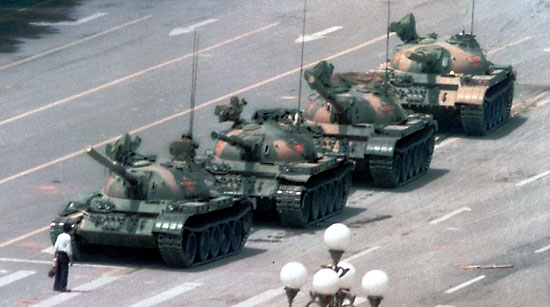 This is one of the coolest and most powerful stories from China's post-Mao protest era. An unidentified, common man threw himself in front of Chinese tanks in order to stop them from coming into the city of Beijing. Witnesses and historians speculated that all he wanted was peace for the people of the city. He has never been officially identified and no one knows what became of him after that day.
The 1989 Tiananmen Square Massacre was filled with other stories of heroism similar to this one. Students protested for days, often running right into open fire and losing life and limb for their beliefs. The real threat the government felt, however, from the protests was not in Tiananmen Square but in areas surrounding the city where the ordinary person had joined in the fight. Up until this point, only students and college communities were protesting from political freedom but this particular movement inspired and motivated working class citizens to join in. This aspect opened the resistance to communism to millions and millions more people. The government realized this day that they had a real situation on their hands and the only way to kill it would be to censor the rest of China and the world from the events and photos from 1989's massacre. They all but wiped out every image and story about Tank Man and others and the movement was squashed. Life went about as normal for the unblissfully ignorant Chinese population as Deng's economic progress continued to move forward.
The Two Chinas
Deng Xioping's economic reform vision continued to be carried out and China grew more quickly than any other industrialized nation in the world. They are a superpower with a rising economy in the world. But that's only one China.
China A- Big Business
Modern, urbanized, rise of criminalization, health system overload, poor education
China B- Underdeveloped, rural
Poor, no growth (growth is in the city), poor water resources, no education
There is a huge inequality here. China B's young people are moving into China A in order to be able to feed and educate theird children, leaving behind parents, their kids, and their China just to survive. It's a difficult situation in which they must surrender or fall behind China A's progress.
I think even China's inequality is wider than the U.S.'s. It's true our top 10% make more than the bottom 50% of the nation, but everyone still pretty much lives in the same world in the U.S. In China, the China A lives in space age while China B appears to live in ancient China with farms and fires everywhere. These people are still not satisfied with life because they are either dirt poor or overworked in dirty factories in China A. It's no wonder they are still uneasy even with ecnomic freedom.
The crazy thing is that protests still happen in China. But, the story of the Tank Man is not one passed on from revolutionary to revolutionary. No one is old enough to have been there or have heard of it. So, the inspiration that could be drawn from it and used as fuel is gone from today's protesters. It was evident from an interview featured in PBS's Frontline presentation on the Tank Man where four young people could not even identify what the picture of the Tank Man was from. It's sad. Even Google and Yahoo have wiped the photos from their Chinese search engines but not their U.S. databases. Clearly, there is a system at work here where economic interests top the rights of the people.
This is one of the coolest and most powerful stories from China's post-Mao protest era. An unidentified, common man threw himself in front of Chinese tanks in order to stop them from coming into the city of Beijing. Witnesses and historians speculated that all he wanted was peace for the people of the city. He has never been officially identified and no one knows what became of him after that day.The 1989 Tiananmen Square Massacre was filled with other stories of heroism similar to this one. Students protested for days, often running right into open fire and losing life and limb for their beliefs. The real threat the government felt, however, from the protests was not in Tiananmen Square but in areas surrounding the city where the ordinary person had joined in the fight. Up until this point, only students and college communities were protesting from political freedom but this particular movement inspired and motivated working class citizens to join in. This aspect opened the resistance to communism to millions and millions more people. The government realized this day that they had a real situation on their hands and the only way to kill it would be to censor the rest of China and the world from the events and photos from 1989's massacre. They all but wiped out every image and story about Tank Man and others and the movement was squashed. Life went about as normal for the unblissfully ignorant Chinese population as Deng's economic progress continued to move forward.
The Two Chinas
Deng Xioping's economic reform vision continued to be carried out and China grew more quickly than any other industrialized nation in the world. They are a superpower with a rising economy in the world. But that's only one China.
China A- Big Business
Modern, urbanized, rise of criminalization, health system overload, poor education
China B- Underdeveloped, rural
Poor, no growth (growth is in the city), poor water resources, no education
There is a huge inequality here. China B's young people are moving into China A in order to be able to feed and educate theird children, leaving behind parents, their kids, and their China just to survive. It's a difficult situation in which they must surrender or fall behind China A's progress.
I think even China's inequality is wider than the U.S.'s. It's true our top 10% make more than the bottom 50% of the nation, but everyone still pretty much lives in the same world in the U.S. In China, the China A lives in space age while China B appears to live in ancient China with farms and fires everywhere. These people are still not satisfied with life because they are either dirt poor or overworked in dirty factories in China A. It's no wonder they are still uneasy even with ecnomic freedom.
The crazy thing is that protests still happen in China. But, the story of the Tank Man is not one passed on from revolutionary to revolutionary. No one is old enough to have been there or have heard of it. So, the inspiration that could be drawn from it and used as fuel is gone from today's protesters. It was evident from an interview featured in PBS's Frontline presentation on the Tank Man where four young people could not even identify what the picture of the Tank Man was from. It's sad. Even Google and Yahoo have wiped the photos from their Chinese search engines but not their U.S. databases. Clearly, there is a system at work here where economic interests top the rights of the people.
Subscribe to:
Posts (Atom)
