Tuesday, February 19, 2008

Killing Democracy Softly in China

The Communists' New Strategy

The article by Kurlantzick brings up a lot of very disturbing events occuring in China right now. He writes about how the Communists are still appeasing its people by providing economic freedom while simultaneously taking away their political freedoms. The real problem is that the Chinese people do not fully grasp this because the government is using subtle tactics to repress people and is extensively censoring the media that happens to catch on to their plans.
Instead of publicly suppressing all religious organizations, political dissidents, or ethnic minorities, Beijing has begun playing groups off each other, sanctioning a few mainstream organizations while quietly but harshly repressing those that challenge the state authority.
Subtle Repression

The situation in China was not always this way. In the 1990s, political activism was openly and severely punished. However, because the new leadership was afraid of repressing free speech and dealing with more dissent, the media was not censored. This allowed domestic and internation news groups to disseminate the information about human rights abuse throughout the world and hurt foreign investment in China's manufacturing industry. The Chinese knew it had to change this or risk falling behind in the the world economy. This is why their current tactics are so bad. They are continuing to fight against the most extremely political dissident groups but allowing more docile ones to flourish, giving China a good reputation without consequences to its current political and human rights situation. China is still just a repressive but no one knows the full extent of it.

Another really harmful issue is using minorities against each other. The government has been using spies in Muslim and evangelical groups in certain regions to report any dissident activities. This keeps the groups in check while increasing the number of watchdogs. Essentially, this is a horrible situation because these minorities could be working together in order to gain more rights and freedoms in China, but instead they are working to thwart each other and essentially helping the govenment to continue to repress them.

Censoring the Media

The Internet has proven to be a big headache for Communists in China. Since this medium allows people to obtain information regarding new ways of thinking and have access to news from all over the world, it has hurt the Chinese Communists' ability to use propaganda on its people. That is, until it was able to censor its nation's Internet and close down cafes where the Internet can be accessed. Thousands of Internet Cafes have been closed recently by the government throughout all of China, so now the Chinese cannot even access it.

Those priviledged enough to have access do not even have full access. The government, working in conjunction with U.S. Intenet search engines and security companies, has devised a way to censor what websites Chinese people can access and what images they are exposed to.
China has the most extensive Internet censorship in the world, with the government regularly denying access to over 19,000 websites.
But the problems continue

This creates a really volatile environment in China where the people are anything but stable:

1)At least 150 million peasants in China have lost their job in the past decade
2)Per capita annual income is only $266 in rural areas
3)Farmlands are being confiscated for housing
4)Labor disputes have been on the rise since 1992

Problems are likely to increase as protests are more frequent and intense. The government, again, is employing a subtle way of taking care of this. Leave the small protests alone and make an example of long-term protests.

West is Key to Repression

The worst part of all is that the outside world knows about these abuses but either have not or cannot do anything about it. Several U.S. companies have been cited to support the government's repression in exchange for business contracts and immunities in China. This is incredibly effective in obtaining foreign investment while allowing the government to continue its corrupt practices. China now has no reason to even try to change its human rights violations because it can have its cake (repression) and eat it too (money).

I honestly think China has moved backwards since Tiananmen. Like we saw in the documentary, any progress made in the past has been erased by the government's censure of media. They are cracking down harder on dissent but portraying themselves as more democratic by covering up with support for state-controlled minority groups that they have under control. China is in trouble and many do not even know it.

Saturday, February 16, 2008

I'm a Tank Man, I'm a Tank Tank Man, Yes I'm a Tank Man.....

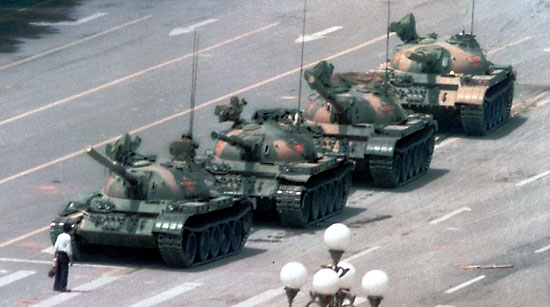
The Tank Man

This is one of the coolest and most powerful stories from China's post-Mao protest era. An unidentified, common man threw himself in front of Chinese tanks in order to stop them from coming into the city of Beijing. Witnesses and historians speculated that all he wanted was peace for the people of the city. He has never been officially identified and no one knows what became of him after that day.

The 1989 Tiananmen Square Massacre was filled with other stories of heroism similar to this one. Students protested for days, often running right into open fire and losing life and limb for their beliefs. The real threat the government felt, however, from the protests was not in Tiananmen Square but in areas surrounding the city where the ordinary person had joined in the fight. Up until this point, only students and college communities were protesting from political freedom but this particular movement inspired and motivated working class citizens to join in. This aspect opened the resistance to communism to millions and millions more people. The government realized this day that they had a real situation on their hands and the only way to kill it would be to censor the rest of China and the world from the events and photos from 1989's massacre. They all but wiped out every image and story about Tank Man and others and the movement was squashed. Life went about as normal for the unblissfully ignorant Chinese population as Deng's economic progress continued to move forward.

The Two Chinas

Deng Xioping's economic reform vision continued to be carried out and China grew more quickly than any other industrialized nation in the world. They are a superpower with a rising economy in the world. But that's only one China.

China A- Big Business
Modern, urbanized, rise of criminalization, health system overload, poor education

China B- Underdeveloped, rural
Poor, no growth (growth is in the city), poor water resources, no education

There is a huge inequality here. China B's young people are moving into China A in order to be able to feed and educate theird children, leaving behind parents, their kids, and their China just to survive. It's a difficult situation in which they must surrender or fall behind China A's progress.

I think even China's inequality is wider than the U.S.'s. It's true our top 10% make more than the bottom 50% of the nation, but everyone still pretty much lives in the same world in the U.S. In China, the China A lives in space age while China B appears to live in ancient China with farms and fires everywhere. These people are still not satisfied with life because they are either dirt poor or overworked in dirty factories in China A. It's no wonder they are still uneasy even with ecnomic freedom.

The crazy thing is that protests still happen in China. But, the story of the Tank Man is not one passed on from revolutionary to revolutionary. No one is old enough to have been there or have heard of it. So, the inspiration that could be drawn from it and used as fuel is gone from today's protesters. It was evident from an interview featured in PBS's Frontline presentation on the Tank Man where four young people could not even identify what the picture of the Tank Man was from. It's sad. Even Google and Yahoo have wiped the photos from their Chinese search engines but not their U.S. databases. Clearly, there is a system at work here where economic interests top the rights of the people.

Tuesday, February 12, 2008

Opening the floodgates of democracy in China

"Prospects for Democracy."

In reading the second excerpt from Guthrie, it really shows that communism in China is vulnerable to collapse. There are several forces from past and present situations that have lead to this unstable state of politics.

Guthrie continues to assert that Deng's push for economic reform and freedom in China is a huge reason that political freedom is increasingly being called for. With private enterprises forming in China, more jobs opened up for young people to take up. These jobs, unlike government jobs, would allow them to express their opinions without fear of losing their job, career, or freedom. Additionally, if college students decide to express support for democracy in their clubs and scholastic life, they still have numerous business-related companies willing and happy to hire them. This type of climate encourages young Chinese to think however they desire.

Then Tiananmen Square protests and subsequent military intervention occured in 1989. This movement seems important for democracy in China for a number of reasons. First of all, students opened the movement to ordinary, less educated citizens in a way it was never available to them before. All of a sudden, a different, much larger population felt power to change their status. Second, the violence taken against the students really showed how oppressive the government was. The pictures and stories spread by the international media also helped to show both internal and external parties that communist forces were using violence to squash something other societies in the world feel is a human right, freedom of expression.

After this pivotal event, free enterprise in China really took off. This lead to another group that erodes the communist hold in China: entrepreneurs and private business owners. These people have security in their businesses and money and this are not fearful of the starvation and loss of jobs that can occur when someone fights the government. Thus, this group is not afraid to fight for democratic practices that would further benefit economy and autonomy for their industries in China.

A final factor in creating an environment for democracy in China is the currently evolving free-flow of information evident not only in China but also the whole world. Journalists in China have more choice in opinion after Tiananmen allowed them to showcase the human rights issues. And now, the Internet has allowed internal journalists to communicate with the world and the world to communicate with China about political issues. Thus, with current technology, people in China are more aware of what other political systems exist in the world.

It makes sense that China is on a path to be more open and grass-roots centered. The people have more choice between communism and other ways and feel less fear that going against the grain will ruin the rest of their lives. The evidence is clear in the dissident blogs scattered all over the Internet.

One such site I visited is . The site is interesting because it not only lists current issues important to non-party members, but it also has a special section devoted to current political prisoners. This can be accessed through Beijing Olympics 2008 Take Action Now! link and selecting one of the photos listed. It provides a face to the human rights violation previously abstract to both the Chinese people and more importantly the rest of the world. A picture of the prisoner featured this month is above. He is one of the brave faces of the new, less cautious Chinese people.

Sunday, February 10, 2008

Deng Didn't Downright Democratize, Duh.

Balancing Development with Democracy

Shaohua Hu explored Deng's policies and politics in this article. Essentially Deng wanted a communist government, like Mao, but saw a lot wrong in the system. He wanted to lead the government and the people in a different way but not with a different way.

Deng's leadership differed in a number of ways:

1) He focused on economic reform. Unlike Mao, Deng thought that as long as people were fed, had jobs, had money, they would be happier than having, say, the right to vote
“It does not take Marx of Maslow to understand why a piece of bread serves a hungry person better than a piece of ballot-paper.”
2)Deng took the focus off of the class-based struggle Mao enhanced. This meant that people would no longer resent the rich but rather work for everyone's good

3)Deng rehabilitated Mao's counter-revolutionary opponents. Mao had failed to get riud of his opposition effectively. This was something Deng made sure to do.

4.) Deng made communists less ideological and more practical. He helped the party members realize that the design and structure of every system was not the most important facet as long as it did what it was supposed to.

5.) Deng opened China up to foreign investment and the world. He knew this would be necessary if China was to emerge as an economic world power. Mao feared this.

Essentially, Deng found a way to make communism meet people's needs the way Mao's communism didn't. Mao made everyone focus on an illusion communism as equaling everyone but Deng showed people that this was not reality. He combated this by making economic reforms that put more control in local and private hands where the individual and the market could make or break a person's prosperity. This allowed people to be happy with their own efforts in the economy while not worrying about their involvement and freedom in politics.

It should not be said that Deng made no political reforms. He did make elections more free locally and reformed the judicial system to be more fair. He knew stability of politics was necessary for the economy to maintain its stability. He did not believe that political reform was necessary in order to bring about social and human rights reforms. He famously stated
"Change in the system. Not change of the system."
This worked for a while until Tiananmen Square happened in 1989. Students and intellectuals demanded rights for themselves and more rights within the current systems. Even still they were not demanding a change to democracy. This movement was squashed as they left peasants out of it and allowed Deng to show the rest of China how wrong the protesters were.

The result was that people unconditionally accepted Deng's communism as long as their economic interests continued to be protected. However, this was doomed to be a short-lived success. As political thinkers have studied in the past, once economic reforms take hold and people become stable with basic needs, they begin to look for more freedoms elsewhere. Because the poor were now fed, the has the energy to realize something else was missing.

This leads us to the protesting of human rights and other ideas happening in Pei's China. People have all the economic growth in the world but feel the government is still treating them bad. Deng may have worked his entire reign to make communist China stand with economic freedom but his intended efforts will lead to an unintended end.

Mao Money, Mao Problems

"Setting the Stage"

The article by Doug Guthrie outlines how Mao Zedong started the People's Republic of China (PRC) in 1949. The leader created a communist government where the state controls almost every facet of life and every person, industry, job, everything is organized, sorted, and distributed the way the government saw fit.

A few key factors defined Mao's China. First, the government encouraged its people to protest and challenge certain conditions existing in China. Mao told the Chinese people to fight against unfair employers, foreign invasion, and anti-communists. He informed them of what was good for them and then encouraged dissent against these institutions. Thus, Mao set the stage for social unrest.

Second, Mao's government controlled production and industry. Factories and agriculture were put under state control and forced to reach production quotas. This enabled Mao to exert control over the supply and demand of the country in 5 year plans.

Finally, China under Mao was organized into collective communities of 30-50 households. The people in each community produced goods and services for the whole to pool resources. However, the goods were distributed according to each home's contribution so the wealthy still received more than the poor. Another cause of social unrest.

Mao Zedong is the father of the conditions Pei stated in the article from my previous entry. He told the Chinese to protest and riot against employment, foreigners, and other evils. Essentially, the climate for social unrest was implanted into Chinese society. The lesson here for the Chinese was that if you don't like something, rise up and change it. We can see this today in China, except now the people are protesting for their own idea of acceptable life.

"But if you go carrying pictures of Chairman Mao... you ain't gonna make it with anyone anyhow."
Deng Changes a Few Things

Guthrie goes on, in this article, to explain how the fall of Mao and his ideas spurred a new way under leader Deng. Deng's plan was to slowly change industry and agriculture from a state-controlled entity to locally owned and monitored one. He also encouraged more foreign investment, and a legal system to ensure corruption would always be stopped. The key here for Deng's success was slow changes. This transformed the environment in China greatly and their economy is the 6th largest in the world to date. However, some problems started under Mao continue to plague China and, again, this can be seen in the conditions of today's China under Jintao.

Saturday, February 9, 2008

China's Progressing while Regressing

"China is Paying the Price of Social Unrest"

The author of this article, Pei, brings up a very interesting and paradoxical point regarding China's transformation in recent decades. China, yes, has definitely grown economically, industrially, and technologically. However, I honestly believe this was something the state desired and instituted.
My basis for this assumption comes from Pei's article. He states that the number of social uprisings has shown staggering increases in recent years.
The number of so-called "mass incidents" (sit-ins, riots, strikes, and demonstrations) reached 74,000 is 2004, an all-time high, and involved about 3.7m individuals. In 1994, by comparison, there were about 10,000 such incidents, with 730,000 participants.
Pei also notes that the triggers for these incidents are social and economic policies, such as high tax and land seizures, that help to facilitate the economic and industrial growth of China. Chinese people may not agree with how their country is changing and be angry that they must pay the price regardless.

This could be avoided with social care of people but such a climate is not present. China does not care for its poor, aging, or other interest groups and so the Chinese people feel they are taken from without being given anything. It's no wonder they are acting out more and more each year.

China wants to fix this so they can have a good reputation with the rest of the world. However, this is not a good reason as this, too, is a corrupt endeavor. The government is corrupt and just wants band-aids for the problems that can easily save face but do not fix the problems (i.e. publicly punish a select few officials while letting other continue their corrupt ways). If this continues, then the protests will, too.

Tuesday, February 5, 2008

How China and the U.S. view the "China Threat"

Reving up the China Threat

In Klare's article regarding how the U.S. defines and is reacting to the rise of China as a superpower, he asks the great question of is China a threat just to the economy of the U.S. and its current position of dominance or does China threaten the security of the U.S. as a state? Also interesting to note is that he separates the two. This leads me to believe that the article focuses on the traditional and dominant discourse of security as solely focusing on military action. However, he also notes that the U.S. will react to economic threats with military force, thus alluding to the idea that security threats can now come from sources other than military action but cannot be resolved in such means yet.

Currently, the U.S. has a system for deciding if another nation-state is posing a threat to security. The criteria are whether the state is becoming a "new rival," is capable of world power, resembles the likes of the Soviet Union, during the Cold War, and is taking in resources and supplies to prepare for military action.

This leads Klare to believe that the U.S. is labeling the Chinese state as a threat to U.S. security. The basis for placing this label rests of a few key issues. First of all, China has been cited as building up its missile and weapon reserves and increasing the missile range around its state. A report filed annually by the government shows that China is growing its missile program. China has begun to purchase submarines, fighter planes, and destroyers. Also, the U.S. claims that the missiles are being aimed at the U.S.'s allies. China has recently been able to afford missiles from Russia capable of reaching Japan and Taiwan.

A good point, to which I agree, that officials in Beijing make for taking such action to build a military defense is just that. It's for China's defense. Klare notes that China is afraid it is being contained and threatened by the bases the U.S. has built around then and the missiles being constantly being pointed at them. This has caused China to be insecure in its own security and has naturally began to take measures to protect themselves. Of course, as Klare also notes,
But any nation, when confronted with a major military buildup by a potential adversary off its shores, is bound to feel threatened and will act accordingly.
Simply put, the reason for China having a missile program is the U.S. started it and the Chinese are just reacting.

Finally, the U.S. is worried because China has tried to buy out a small California-based oil company and is threatening to change the flow of oil distribution throughout the whole world. It is well-known that oil is not an infinite resource and is the most demanded raw material in the world. This makes the good a source of life and power in the world. Since China has grown, it has increased its oil consumption tremendously without the prospect of more oil being created in the world. Now, the U.S. is feeling threatened that China will take away the oil America needs and, thus, shift its position of power to below China. This shows that the actors remain the two states (China vs. U.S.) but the issue of security now moves into new, economic, territory. To the U.S., if China starts to ally with Saudi Arabia and other oil-rich, yet troubled nations, this will threaten the economic and military power the U.S. has had in the past.

However, it is interesting to note here that even though the security issue here is not over a military threat, the U.S.'s solution is still to use military force. Klare goes on to note that U.S. will kill the threat by placing more bases around China and maintain its superiority in military technology. The feeling I get from the article is that the U.S.'s notion of China as a threat still pits state against state and focuses on both military and economic threats. What the U.S. leaves out that should be prominent in the modern notion of security is including oil businesses, individuals, and MNCs as actors and using means other than military to react the the threat perceive from China.

Discourses of Security in China: Towards a critical turn?

After reviewing how the U.S. perceives security regarding China, I looked at how China views the notion of security of itself against others. Clearly, China's notion matches the U.S. in that it believes security lies solely in protecting one's state against the threat of another state, although this is not openly stated in Zhang;s article.

China is a very insecure nation for the reasons Klare states in his article. China is seen as a global threat by other nations for the fact that China is a rising power, and non-democratic at that. Thus, China's view on security is forced to be a reactionary one. China knows that the global economy and identity can impact their security but officials in Beijing have to focus on military because it seems to be the most immediate and dangerous threat at this time.

It's important to look at the history and environment of China to correctly understand their view on security. China was never a wealthy nation but is becoming one. Also, China knows we are in a post-Cold War era and its identity as a communist nation automatically labels it a threat to liberal, democratic nations of the world. So, the view from state actors is that China is being looked at even more closely that any other nation.

Chinese scholars have not put much work into the field of security yet, so all of their notions are based on security of past eras. However, new discourses are emerging and China is waiting to see where this leaves them. There is a possibility, as Zhang states, of superpowers falling to a level where multiple powers can emerge and be on a more level field. This multi-polarity will change the actors of security (perhaps make room for more individual and community actors) and also what security entails (protection of resources, economy, etc. will be included). Or, will security only expand to other areas but not other actors?

Security in China is very complex and still unknown. Currently, China is in reactionary mode to the rest of the world's disdain for non-democratic ideals. However, if China's economic power grows and it is able to become an even player on the global stage, this notion may change and security will then start to encompass ideas other than military and actors other than states.